Rhosyn
The Ballad of the Last DragonRhosyn is both the apparent obstacle to Sylvaine Abelan and one of the story’s most consequential agents of change. Publicly, she is Jaromir’s betrothed; privately, she is a widowed mother defending the home Damir built for their daughters. Her position exposes how family duty, grief, gendered inheritance, and love can become entangled, while her eventual intervention turns a seemingly private romantic crisis into a reform of Kalinia’s law.
Identity and Background
Rhosyn has known Jaromir since childhood. Thalon identifies her as part of the same small circle in which he grew up with Jaromir and Damir, placing her relationship with both brothers within a long history rather than a recent arrangement. Her connection to Jaromir is therefore grounded in familiarity, friendship, and shared family circumstances before it is defined by betrothal.
That betrothal exists because Rhosyn is Damir’s widow. The revelation reaches Sylvaine through Thalon’s careless announcement that Jaromir has a betrothed, followed by Jaromir’s confirmation that his agreement is with Damir’s widow. The information changes the emotional meaning of Jaromir’s secrecy: Rhosyn is not an arbitrary political match but the surviving wife of his dead brother, and the proposed marriage is tied to Jaromir’s sense of responsibility toward Damir and Damir’s family.
Rhosyn’s vulnerability is material as well as emotional. She fears that her daughters will lose their home because Kalinia still follows an archaic rule under which the town absorbs an inheritance when there is no suitable male heir. The broader royal reforms allowing next of kin to inherit, even through a will, have not yet been accepted by Kalinia’s local magistrate. Her household therefore stands at the intersection of private bereavement and public discrimination.
Betrothal and the Domestic Stakes
Rhosyn does not want to marry Jaromir. She tells Sylvaine that she has always regarded him as Damir’s brother and as her friend, possessing friendship and respect but not romantic love. At the same time, she does not dismiss the arrangement as meaningless. She and Jaromir had agreed to live as unattached people before the wedding, each free to seek pleasure elsewhere, but they intended to treat the marriage rites seriously once the winter union took place. Her account makes the arrangement ethically complicated: it is emotionally unfulfilled, yet socially and practically binding.
The planned wedding is only a few months away. With Harvest Day approaching and winter following soon after, the timetable gives the revelation immediate force for Sylvaine and makes Jaromir’s divided loyalties impossible to postpone. Jaromir insists that his attachment to Rhosyn is no deeper than paperwork and declares that he has no attachment to anyone but Sylvaine, but Rhosyn’s own explanation shows why the papers carry such weight. The marriage is connected to Damir’s death, the preservation of his children’s home, and the continuity of his family.
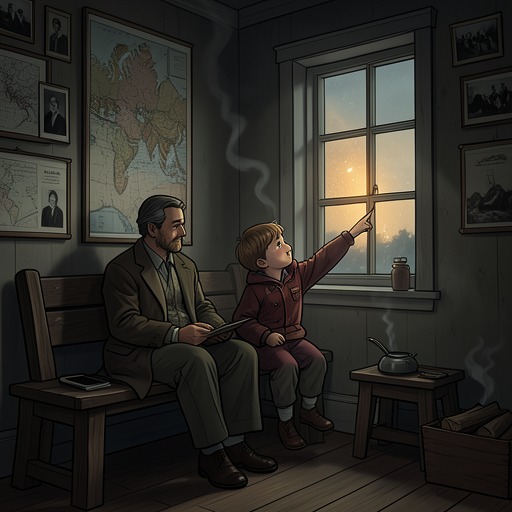
Her grief is expressed through the house itself. Damir built it, and Rhosyn feels that part of him remains in its ordinary imperfections: a creaking floorboard and a nail on the third step that he never fully hammered down. She cannot bring her daughters’ father back, but his touch survives throughout the rooms. The land also carries an older inheritance, having belonged to Damir’s father and grandfather, and represents the future Rhosyn and Damir once imagined for their daughters. Her attachment is thus not sentimental weakness; it is a memory-bearing claim to place, family, and continuity.
Agency and Legal Resistance
Rhosyn has already petitioned Kalinia’s magistrate repeatedly, without success. The local government is not required to adopt Queen Dhara’s newer by-laws, and the town continues to preserve its male-heir inheritance regime. Her failed petitions demonstrate the limits placed on her by the existing structure: the law threatens her home, while the official empowered to change it has little incentive to surrender a system that allows the town to take property from vulnerable families.
When the later petition is brought before Magistrate William M. Ridion, Rhosyn does not remain a silent beneficiary of someone else’s intervention. She rises and states the demand herself. She requires the magistrate to abandon the antiquated inheritance law, prevent people from being expelled from their homes after family tragedies, serve the people rather than profit from their vulnerability, and enact Queen Dhara’s inclusive land and title policies so that any person can establish a life in Kalinia. Her language joins the personal and the structural: the immediate subject is her home and her daughters, but the amendment is meant to protect every person facing the same danger.
Rhosyn’s demand is backed by a carefully prepared legal instrument. While she paced around her kitchen, Sylvaine drafted the legislative document on Rhosyn’s table. Rhosyn’s prior petitions and Sylvaine’s written proposal therefore work together: Rhosyn supplies the knowledge of the injustice and the authority of the person endangered by it, while Sylvaine supplies a tactical and notarial method for forcing the magistrate to act. When Ridion protests that proper documents, a scribe, and a notary will take time, the prepared text removes those excuses and makes immediate signature and sealing possible.
Relationship with Jaromir and Sylvaine
Rhosyn’s relationship with Jaromir is shaped by lifelong familiarity, Damir’s death, and a mutual recognition that duty does not automatically create love. Jaromir had been prepared to accept the marriage as the right thing to do after what he considers his failures toward Damir. His later love for Sylvaine turns that acceptance into a crisis, but Rhosyn’s account reveals that the crisis does not arise from a hidden romance between the betrothed pair. She has never loved Jaromir in that way and does not seek to possess him.
Her position also complicates Sylvaine’s initial sense of betrayal. Sylvaine experiences Rhosyn’s name as a wound because Jaromir pursued intimacy while already pledged, yet Rhosyn herself is not presented as a jealous antagonist. She is a woman trying to preserve her daughters’ home under a legal order that treats her family as disposable. The story consequently shifts the conflict away from rivalry between women and toward the obligations and institutions that have made their lives collide.
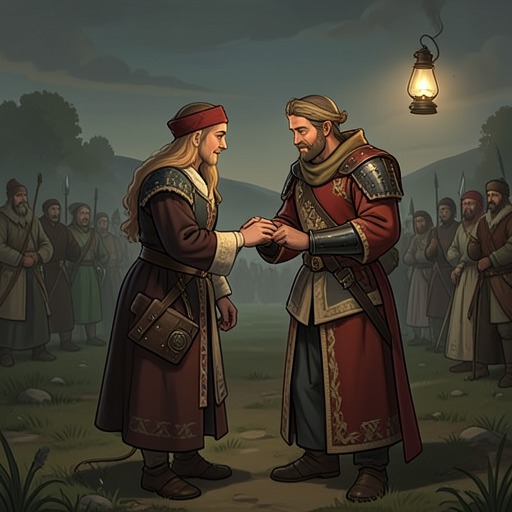
Rhosyn ultimately acts with generosity toward both Jaromir and Sylvaine. After the legal victory, she intercepts Jaromir before the unresolved tension between him and Sylvaine can become a confrontation. She embraces him, whispers to him, and receives his nod; he answers with a chaste kiss at the side of her head before looking back toward Sylvaine. The gesture acknowledges their history without renewing the marriage claim. It gives Jaromir emotional permission to face what comes next while affirming that Rhosyn’s bond with him has not been erased by the dissolution of the arrangement.
Change and Narrative Significance
Rhosyn begins within an arrangement that seems to make her the barrier between the central lovers, but the fuller account of her circumstances transforms that role. She is a widow, mother, lifelong friend, and threatened landholder whose legal predicament explains the practical foundation of Jaromir’s intended marriage. Her story gives concrete stakes to the inheritance regime: without reform, the loss of Damir would also mean the loss of the home in which his daughters’ future was imagined.
Her decisive change is not a conversion from passivity to courage; the evidence shows that she had already petitioned the magistrate repeatedly. Instead, the turning point is the expansion of her resistance from unsuccessful private appeals to a direct public demand backed by an enforceable document and the threat of Sylvaine’s song exposing the magistrate’s conduct. Rhosyn becomes the claimant whose personal crisis forces the local authority to recognize a broader principle of inclusive ownership.
The ending grants her neither a conventional romantic reward nor a diminished role after the betrothal is resolved. She retains her home and her daughters’ future through legal reform, while Jaromir is released from a marriage he never wanted and Sylvaine is no longer required to imagine Rhosyn as an unseen rival. Rhosyn’s invitation to celebrate closes the conflict in a communal register: the result belongs not only to a couple whose relationship may now develop freely, but also to a mother who has defended a house, a memory, and the right of families without male heirs to remain rooted.